Skip to content
NewYork3PL Get specifics
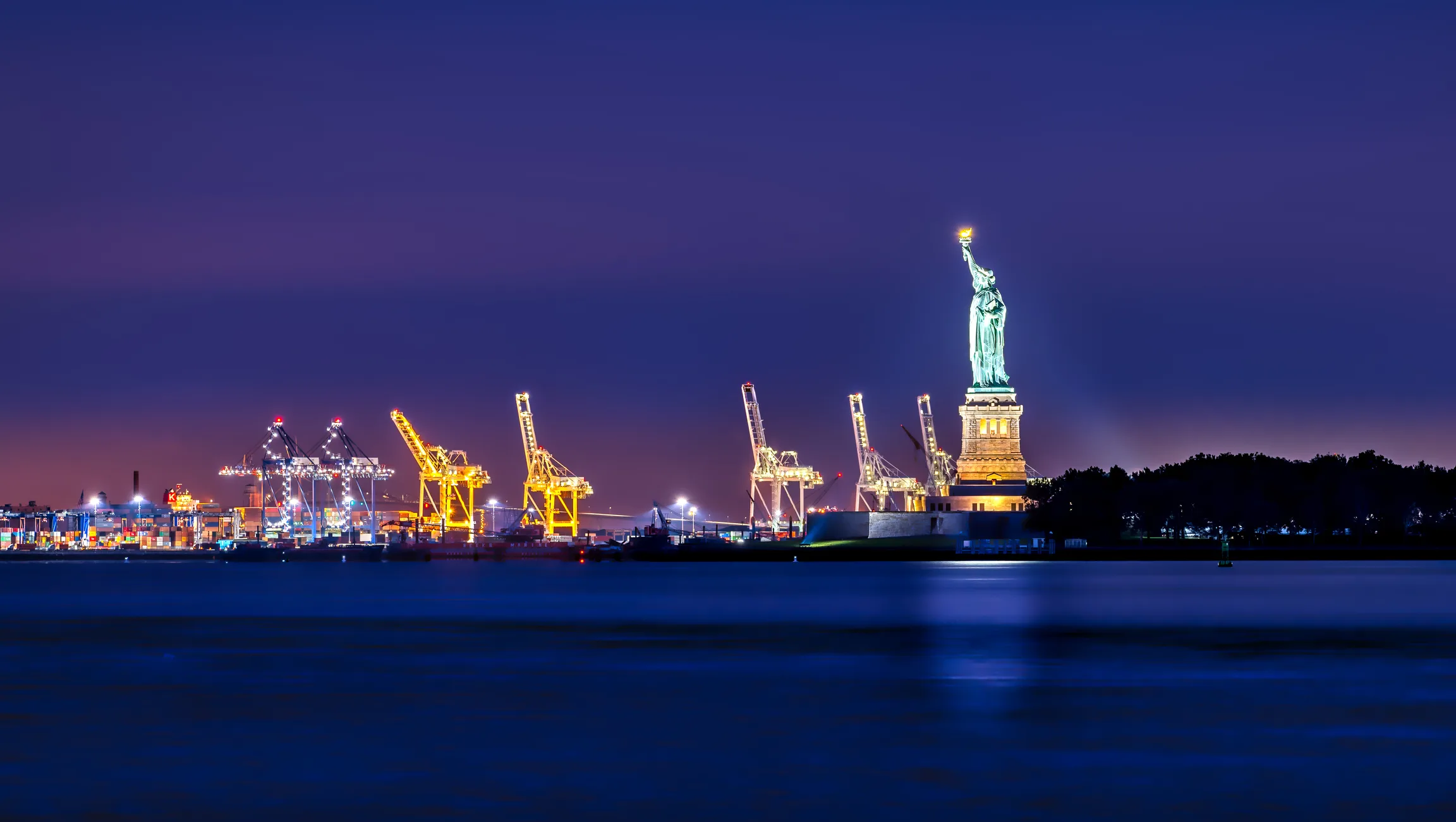
The Port of New York at dusk: illuminated container terminal cranes alongside the Statue of Liberty under a deep purple sky, calm harbor water in the foreground

The Port of New York

The harbor that moves the Northeast.

8.7 million TEU. Four marine terminals. Two railroads. Where every routing decision starts.

Port of NY/NJ 2024 #1 US port for refrigerated

By the numbers

The third-busiest container port in the United States.

The Port of New York and New Jersey moved 8.7 million TEU through its four marine terminals in 2024 — an 11.4% year-over-year increase, and the busiest container port on the East Coast. The harbor is also the #1 US port for refrigerated cargo and a national gateway for furniture, apparel, vehicles, machinery, and consumer goods entering the Northeast.

  • 8.7M TEU Container volume · 2024
  • 2.3M tons JFK + EWR air cargo · 2024
  • 4 terminals Port Newark · Elizabeth · Howland Hook · Red Hook
  • 2 Class I railroads CSX Kearny · Norfolk Southern Newark

The terminal portfolio

Four marine terminals. Two states. One harbor.

Choosing the right terminal isn't a clerical decision — it's an operational one that determines drayage cost, transit time, customs friction, and last-mile reach. Each terminal handles different cargo profiles, operates under different working agreements, and connects to different intermodal corridors.

  1. Port Newark Container Terminal

    Port Newark, NJ

    Operators: PNCT (Ports America + Terminal Investment Limited)

    Primary cargo: Containerized general cargo — apparel, electronics, furniture, machinery

    The principal container facility for northeastern North America. Direct connection to CSX Kearny and Norfolk Southern Newark via the ExpressRail intermodal network. Major hub for Vietnam, China, and India container imports.

  2. Elizabeth Marine Terminal

    Elizabeth, NJ

    Operators: Maher Terminals · APM Terminals Elizabeth

    Primary cargo: Containerized cargo — high-volume mixed consumer goods, automotive parts

    The largest combined container facility on the East Coast. Maher Terminals is the largest privately-held marine terminal operator in North America. APM Terminals Elizabeth is operated by the Maersk-affiliated APM Terminals network — direct lift on/lift off connection to Maersk and 2M alliance vessels.

  3. Howland Hook Marine Terminal

    Staten Island, NY

    Operators: New York Container Terminal (OOCL)

    Primary cargo: Containerized cargo — refrigerated reefer corridor, perishables, NY-bound consumer

    Transferred to New York City ownership from PANYNJ in May 2024. The principal Staten Island gateway and a key node in the brand's reefer routing for fresh produce, frozen seafood, and pharma cold-chain destined for NYC retail and hospital networks.

  4. Red Hook Container Terminal

    Brooklyn, NY

    Operators: Red Hook Container Terminal (Phoenix Beverages affiliate)

    Primary cargo: Containerized cargo — Brooklyn-anchored, last-mile-adjacent

    Transferred to NYC ownership in May 2024 (alongside Howland Hook). The only major container facility located inside the five boroughs proper. Reduces last-mile drayage distance for Brooklyn and Manhattan-bound cargo by 15–35 miles vs. NJ-side terminals.

Intermodal rail

Two Class I railroads. Four ExpressRail facilities.

For inbound containers heading inland — Pittsburgh, Chicago, the Midwest, the Southeast — the routing decision starts with which Class I railroad to ramp the box onto. The wrong choice adds days to transit and dollars per mile. The right one keeps the freight off congested I-78 and the Holland Tunnel.

Class I · East

CSX Kearny Intermodal Terminal

Kearny, NJ

CSX Transportation's primary Northeast intermodal hub. The default ramp for Midwest and Southeast inland routing. Lift fees and per-container cost structure differ from Norfolk Southern — ramp choice can swing landed cost by $200–$400 per container depending on destination.

  • Direct service to:Chicago · Cincinnati · Atlanta · Jacksonville
  • Service type:Domestic intermodal
  • ExpressRail connection:Near-dock via PANYNJ network

Class I · East

Norfolk Southern North Jersey Terminal

Newark, NJ

Norfolk Southern's full-service intermodal terminal with direct on-dock and near-dock ExpressRail connections. Often the better choice for the Ohio Valley, the Tennessee manufacturing belt, and the Southeast — and for international intermodal moves originating at Maher or APM Elizabeth.

  • Direct service to:Pittsburgh · Cleveland · Columbus · Memphis · the Gulf
  • Service type:Domestic + international intermodal
  • ExpressRail connection:On-dock at Maher and APM

The drayage decision

Four decisions before the box leaves the chassis.

Every container that lands at the harbor goes through the same operational decision sequence — and most 3PLs only seriously think about one or two of these. Getting all four right is what separates a routing decision from a routing guess.

  1. Container class & equipment

    Is it a 40-foot dry, a 45-foot high-cube, a 53-foot domestic, a refrigerated reefer, a flatcar, or a break-bulk load? The right chassis, the right tractor, the right driver classification, the right reefer plug-in window — wrong equipment at the gate adds 6+ hours of re-handle and triggers detention fees that compound every hour.

  2. Submarket destination

    Bronx versus Brooklyn versus Queens versus Northern New Jersey is a 22% cost spread on last-mile delivery into NYC proper. Even before unloading, the routing decision needs to know which submarket dock the freight is heading to — staging at the wrong terminal can cost four to six hours of unnecessary drayage and force an overnight hold.

  3. Modality — truck or rail

    For inland-bound freight, the decision is drayage direct to the consignee or ramp at CSX Kearny / NS Newark for intermodal. Direct truck is faster end-to-end for Northeast destinations under 350 miles. Intermodal rail wins on cost and emissions for Pittsburgh, Cleveland, the Midwest. The break-even point is roughly 300–400 miles depending on the cargo class and the carrier rate at the moment.

  4. Window — permits and appointments

    Manhattan delivery runs on permit windows that most national 3PLs don't budget for — 7 a.m. to 7 p.m. for the largest truck classes in most zones, with overnight clearance available for select corridors. Add port appointment systems (PortPro, Voyage Control) that govern when a container can even leave the gate. The operational schedule starts at the dock, not at the destination.

Brief us on the harbor work

Bring us the container no one else has routed.

Drayage, intermodal, customs, last-mile. We'll bring back the route, the warehouse, the team, and the timeline.

New York 3PL The 36th Chamber of Logistics