Skip to content
NewYork3PL Get specifics
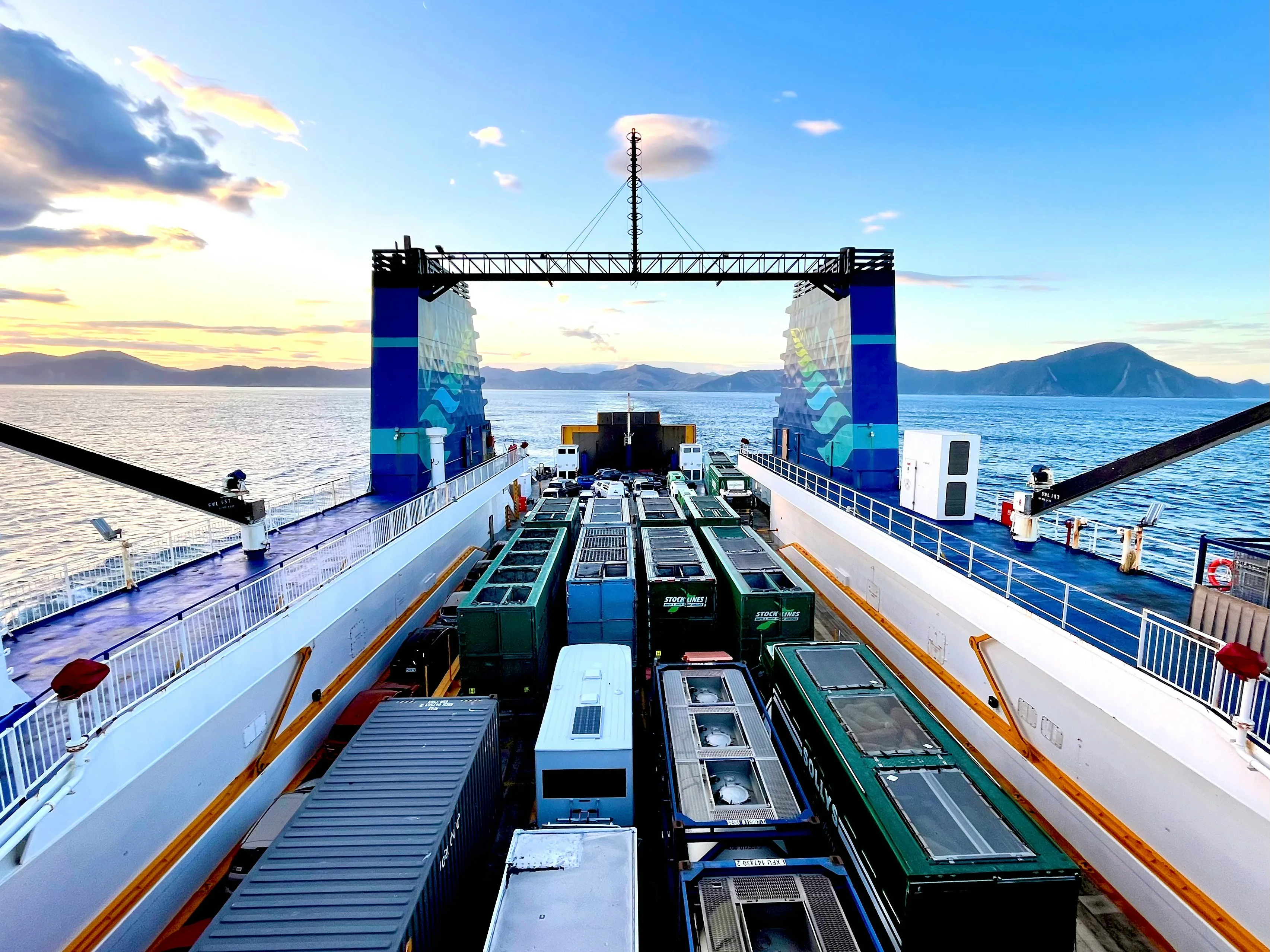
Aerial view from a ro-ro vessel deck looking down at multiple cargo trailers and containers loaded across the ship's deck under golden-hour sky, with coastline and water flanking the vessel. Multi-cargo freight infrastructure typical of the Port of New York and New Jersey throughput across all seven cargo-class sectors NewYork3PL routes.

Sectors

Seven cargo classes. One port. One team.

Refrigerated. Furniture. Apparel. Vehicles. Machinery. Electronics. Specialty. Each routed with cargo-class fluency, not generic 3PL framing.

Refrigerated Furniture Apparel Vehicles Machinery Electronics Specialty

The thesis

Industry verticals are the wrong taxonomy. Cargo class is the right one.

What the port handles is what we route.

Most 3PLs organize their service set around industry verticals — fashion 3PL, pharma 3PL, food and beverage 3PL. The taxonomy makes sense for marketing pages. It doesn't map to how freight actually moves through the Port of New York and New Jersey.

Cargo class is what the port handles. Reefer containers move differently than dry containers. Ro-ro vehicles move differently than containerized cargo. High-cube furniture containers compete for the same drayage chassis as apparel containers but require a different downstream warehouse footprint. The terminal you arrive at, the chassis you book, the warehouse you stage at, the last-mile route you take — these are cargo-class decisions, not industry decisions.

We organize the firm around cargo class because that's what the work actually requires. The seven sectors below correspond to the seven cargo flows that dominate Port of NY/NJ throughput — verified against PANYNJ's 2024 cargo composition data, not invented to fill a marketing matrix.

A fashion-brand pallet and a furniture-brand pallet have more in common than two pallets of fashion.

PANYNJ — #1 US port for reefer #1 US port

Refrigerated cargo (reefer)

The Port of New York and New Jersey moves more refrigerated container volume than any other US port — pharmaceutical cold-chain from European and Asian origins, frozen seafood from Northern European and Atlantic-coast fisheries, fresh produce from South America and the Caribbean, dairy, wine, and spirits from across both oceans. NYC is the largest single concentrated demand market for cold-chain cargo on the eastern seaboard, with hospitals, retail chains, restaurant groups, and beverage distributors as the downstream endpoints.

The reefer corridor operates as continuously temperature-controlled infrastructure — reefer-specific drayage chassis with continuous power monitoring, multi-zone cold-chain partner facilities, time-temperature compliance reporting at every transfer point. The Howland Hook reefer corridor and Port Newark reefer operations are the focal terminals.

Origins
Vietnam · Mexico · Ecuador · France · Italy · Costa Rica · Peru
Terminals
Port Newark · Howland Hook reefer corridor
Sub-classes
Pharmaceutical · Biotech · Fresh produce · Frozen seafood · Dairy · Wine · Spirits
Read deeper on refrigerated

Vietnam dominant origin (60%+)

Furniture, bedding & home goods

NYC is one of the country's largest furniture import markets — design showrooms in the Gramercy/Flatiron district, residential demand across high-rise Manhattan and Brooklyn, hospitality fit-outs for hotels and restaurants, contract furniture for commercial offices. Furniture imports flow primarily through Port Newark Container Terminal in 40-foot and 53-foot high-cube containers; the cargo class is unique because it combines high cubic volume with relatively low weight per cubic foot, making container utilization the operational concern rather than weight optimization.

Vietnam dominates origin volume — 60+ percent of US furniture imports now route from Vietnamese factories — followed by China, Indonesia, India, and Thailand. Upholstered seating has shown +44% YoY growth, and mattress imports have become a meaningful sub-category of their own. Downstream operations are NYC-specific: white-glove inside-delivery, building-access protocols for high-rise residential, freight-elevator scheduling, and the borough-by-borough cost mathematics that determines whether a Manhattan delivery is profitable.

Origins
Vietnam · China · Indonesia · India · Thailand
Terminals
Port Newark Container Terminal
Sub-classes
Upholstered seating · Wood furniture · Mattresses · Home decor · Lighting · Hospitality fit-out
Read deeper on furniture,

Sourcing diversifying out of China

Apparel, textiles & footwear

The NYC apparel market is built on three legs: the Garment District wholesale and showroom concentration, the borough-distributed fashion DTC brand cluster, and the broader Northeast retail demand market that NYC serves as the import gateway for. Apparel imports flow through Port Newark and Elizabeth Marine Terminal in dry containers — 20-foot and 40-foot, mixed by SKU class and brand.

Origin sourcing is in active diversification: legacy China-dominant supply chains are shifting to Vietnam (now the second-largest apparel origin for US imports), India, Indonesia, and Bangladesh. Each origin shift creates documentation and customs implications — different HS codes, different duty rates, different country-of-origin certificate requirements. Downstream the cargo class breaks into seasonal collections, basics replenishment, footwear, and technical fabrics, each with distinct fulfillment cycle and DC strategy.

Origins
Vietnam · China · India · Indonesia · Bangladesh
Terminals
Port Newark · Elizabeth Marine Terminal
Sub-classes
Seasonal collections · Basics · Footwear · Technical fabrics · Luxury · Fast fashion · DTC
Read deeper on apparel,

Port Authority Auto Marine Terminal

Vehicles & roll-on/roll-off (ro-ro)

Vehicle imports through the Port of New York and New Jersey route through the Port Authority Auto Marine Terminal — purpose-built ro-ro infrastructure for passenger vehicles, commercial vehicles, and heavy machinery. Premium European brands (German luxury, Italian sports, Swedish premium) and Japanese passenger autos make up the historical baseline; the fastest-growing sub-segment is EV imports from Asian manufacturers, which create new downstream operational requirements (battery handling, charging logistics, heightened HazMat documentation).

Downstream of the Auto Marine Terminal, vehicles distribute to dealer networks across the Northeast through specialized auto-haul carriers. Commercial vehicles — work trucks, vans, fleet vehicles — flow through the same terminal but with different downstream routes, typically toward Northeast fleet and rental customers. Heavy machinery on ro-ro vessels requires project-cargo handling protocols at the terminal and onward.

Origins
Germany · Japan · South Korea · Sweden · China (EV)
Terminals
Port Authority Auto Marine Terminal
Sub-classes
Passenger vehicles · Commercial vehicles · EVs · Heavy machinery · Project cargo
Read deeper on vehicles

Capital equipment imports

Machinery & industrial equipment

Industrial machinery imports to the Northeast manufacturing corridor — pumps, compressors, semiconductor and aerospace manufacturing equipment, precision tooling, machine-tools — flow primarily through Port Newark Container Terminal. The cargo class is dominated by high-value, low-volume capital equipment shipments where customs documentation, project-cargo handling, and chain-of-custody integrity matter more than raw freight rate.

Origin volumes are German-dominant for precision tooling and machine-tools, with Japan and South Korea strong for semiconductor and aerospace manufacturing equipment, and China growing for industrial machinery and pumps. Downstream, the cargo flows to manufacturing customers in NJ, PA, and the broader Mid-Atlantic — often with installation-site delivery requirements that go beyond standard freight (rigging, crane work, on-site assembly coordination).

Origins
Germany · China · Japan · Italy · South Korea
Terminals
Port Newark Container Terminal
Sub-classes
Industrial machinery · Pumps and compressors · Semiconductor equipment · Aerospace · Precision tooling
Read deeper on machinery

High-value, security-sensitive

Electronics & precision components

Electronics imports — circuit boards, semiconductors, electric motors, optical and medical instruments, consumer electronics, telecom equipment — flow through Port Newark Container Terminal with security and handling requirements that distinguish them from standard cargo. The cargo class is high-value-per-unit, which drives chain-of-custody, sealed-container, and theft-prevention protocols throughout the operational chain. Insurance and customs requirements are also more involved — high-value declarations, classification audits, and compliance documentation that hold up to regulatory scrutiny.

China remains the largest origin for consumer electronics, but Vietnam, Taiwan, Thailand, and Mexico have grown significantly as manufacturing diversification accelerates. Specific sub-classes — medical devices, semiconductor wafers, military and dual-use components — carry their own regulatory regimes (FDA, BIS, ITAR) that we coordinate documentation for at the port.

Origins
China · Vietnam · Taiwan · Thailand · Mexico
Terminals
Port Newark Container Terminal
Sub-classes
Circuit boards · Semiconductors · Electric motors · Optical instruments · Medical instruments · Specialty lighting
Read deeper on electronics

Plastics, chemicals, materials, project cargo

Specialty & multi-category cargo

The catch-all cargo class covers freight that doesn't fit a single primary bucket but still flows through PANYNJ at meaningful volume. Plastics and resins (the Northeast is in the top 3 nationally for plastic resin imports), building materials and stone, automotive parts, toys and sporting goods, specialty chemicals (with HazMat documentation requirements where applicable), agricultural commodities, and project cargo that needs custom routing because it's oversize, overweight, or has non-standard handling requirements.

Each sub-class has its own operational profile — plastics in dry containers from China and the Middle East; stone and tile from Italy and Turkey; specialty chemicals with regulatory and HazMat requirements; project cargo on flat-rack or break-bulk vessels with specialized rigging at the terminal. The taxonomy converges on one principle: when the cargo doesn't fit a standard bucket, the routing decision needs to be customized rather than forced into a generic shipping plan.

Origins
China · Germany · Italy · Mexico · India · Saudi Arabia
Terminals
Port Newark Container Terminal · Break-bulk facilities
Sub-classes
Plastics & resins · Building materials & stone · Auto parts · Toys & sporting goods · Specialty chemicals · Agricultural commodities · Project cargo
Read deeper on specialty

The port that shapes the taxonomy

The Port of New York and New Jersey is the largest container port on the East Coast.

  • 8.7M TEU

    Annual container volume at the Port of NY/NJ — third-largest US port, largest on the East Coast

  • #1 US port

    Refrigerated container cargo throughput

  • 4 marine terminals

    Port Newark, Elizabeth, Howland Hook, Red Hook — plus the Auto Marine Terminal for ro-ro

The Port of New York and New Jersey handles approximately 8.7 million twenty-foot-equivalent units (TEU) annually — the third-largest container port in the United States by volume and the largest on the East Coast. The port complex aggregates four marine terminals across Newark, Elizabeth, Staten Island (Howland Hook), and Brooklyn (Red Hook), plus the Port Authority Auto Marine Terminal for ro-ro vehicle imports. Each terminal handles different vessel classes and different intermodal connections.

PANYNJ is the #1 US port for refrigerated container cargo, the dominant Northeast gateway for furniture and apparel imports from Asia, the primary East Coast vehicle-import terminal, and a major channel for industrial machinery, electronics, and specialty cargo. The cargo composition of the port shapes our service offering — we organize around what flows through, not around generic 3PL category structure.

If it goes through PANYNJ, we route it. If it doesn't yet, we'll figure out which class it belongs to.

New York 3PL The 36th Chamber of Logistics